IBKR Tiered vs Fixed: Complete Interactive Brokers Fees Guide (2026)
Choosing between IBKR Tiered vs Fixed pricing is one of the most critical decisions for any Interactive Brokers investor.
The short answer is clear: for over 90% of retail investors, Tiered pricing is significantly cheaper than Fixed pricing.
With Tiered pricing, you can trade US stocks and ETFs for as low as $0.35 per order, compared to a $1.00 minimum on Fixed.
Hi, I'm Tim, the founder of Sunfortzone and a long-time Interactive Brokers user.
When I first started investing with IBKR since 2021, analyzing their extensive fee schedules felt overwhelming and confusing.
Every hard-earned dollar lost to unnecessary brokerage commissions represents lost future compounding returns.
In this comprehensive guide, we break down exact math, exchange fees, and real-world trades so you stop overpaying.
| Pricing Feature | Fixed Pricing | Tiered Pricing | Winner for Retail Investors |
| Base Commission | $0.005 per share | $0.0035 per share | Tiered ($0.0035 vs $0.005) |
| Minimum per Order | $1.00 minimum | $0.35 minimum | Tiered ($0.35 vs $1.00) |
| Maximum Commission | 1.0% of trade value | 1.0% of trade value | Tie (Both 1.0% max) |
| Exchange & Clearing Fees | Included in base fee | Passed through at cost | Fixed includes; Tiered adds ~$0.003 |
| Liquidity Rebates | No rebates available | Earn cash rebates on limit orders | Tiered provides rebates |
| Typical Cost (10 shares) | $1.00 | ~$0.38 - $0.40 | Tiered saves over 60%! |
Understanding Interactive Brokers Fees: Fixed vs. Tiered at a Glance
To understand interactive brokers fees, you must recognize that IBKR is an institutional-grade platform built for direct market access.
Unlike commission-free brokers that profit from Payment for Order Flow (PFOF), IBKR delivers transparent order execution.
When you open an account, IBKR sets your default commission plan to Fixed pricing.
Under Fixed pricing, you pay a flat $0.005 per share with an absolute minimum fee of $1.00 per trade.
All exchange fees and clearing costs are bundled into that rate, providing simple predictability.
However, this simplicity often costs retail investors nearly three times more than necessary.
How IBKR Tiered Pricing Works: The $0.35 Minimum Advantage
With ibkr tiered pricing, your base commission drops from $0.005 down to $0.0035 per share.
More importantly, the minimum fee per trade drops from $1.00 to just $0.35.
For anyone practicing dollar-cost averaging (DCA), this difference compounds into enormous lifetime savings.
If you invest $500 monthly across three ETFs, Fixed pricing charges you $3.00 in minimum commissions.
Under Tiered pricing, those exact three orders cost approximately $1.15 in total.
Over a decade of monthly contributions, switching saves you hundreds of dollars in friction costs alone.
Interactive Brokers Commissions Compared: Real Trade Scenarios
Let us examine real mathematical examples of interactive brokers commissions across different order sizes.
Suppose you purchase shares of a stock priced at $100 per share, such as Apple or an S&P 500 ETF.
| Order Size (US Stocks) | Shares Purchased | Fixed Pricing Total | Tiered Pricing Total | Best Choice |
| $100 (Small/Fractional) | 1.0 Share | $1.00 (1.0% cap) | $0.35 - $0.38 | Tiered (Saves 62%) |
| $500 Trade | 5 Shares | $1.00 | $0.37 | Tiered (Saves 63%) |
| $1,000 Trade | 10 Shares | $1.00 | $0.38 | Tiered (Saves 62%) |
| $5,000 Trade | 50 Shares | $1.00 | $0.52 | Tiered (Saves 48%) |
| $10,000 Trade | 100 Shares | $1.00 | $0.70 | Tiered (Saves 30%) |
| $25,000 Trade | 250 Shares | $1.25 | $1.62 | Fixed (Saves $0.37) |
| $5,000 (Penny Stock, $2/sh) | 2,500 Shares | $12.50 | $16.25 | Fixed (Saves $3.75) |
Understanding Third-Party Exchange Fees and Liquidity Rebates
Many investors hesitate to switch because of unfamiliarity with interactive brokers exchange fees.
Under Tiered pricing, third-party exchange and clearing fees are passed through directly at cost.
Clearing fees equal approximately $0.00020 per share, while regulatory fees on selling are fractions of a cent.
When you submit a market order, you remove liquidity from the order book and pay a small exchange fee.
Conversely, when you place a patient limit order, you add liquidity and can earn an interactive brokers liquidity rebate.
These exchange rebates can offset your base commission, resulting in net fees as low as a few pennies!
IBKR Fixed vs Tiered: When Does Fixed Actually Win?
While Tiered pricing dominates for retail investors, ibkr fixed vs tiered is not a one-size-fits-all rule.
Fixed pricing becomes advantageous when you trade large quantities of low-priced shares.
Because US brokerage fees are charged per share rather than strictly per dollar, share count matters greatly.
Buying 2,000 shares of a $2 stock costs $10.00 on Fixed (2,000 x $0.005).
On Tiered, 2,000 shares incur $7.00 base commission plus around $6.00 in exchange fees, totaling $13.00.
On discussions across interactive brokers tiered vs fixed reddit communities, experienced traders agree:
"If you buy index funds, blue chips, or fractional shares under 200 shares per order, Tiered is king."
For European and international investors buying US ETFs, the ibkr minimum fee of $0.35 makes regular investing viable.
Why do you choose a broker that you need to pay commissions rather than a free-commission broker?
While commission-free brokers can be tempting at first glance, there are some potential downsides to consider before you ditch the traditional commission-based broker altogether. Here's why a commission-free broker might not always be the best choice:
Hidden Costs:
- Bid-Ask Spread: Commission-free brokers may widen the bid-ask spread, which is the difference between the price you can buy and sell a security, also called asks and bids respectively. This means you might be paying more than you realize for each trade, even though there's no upfront commission.
- Order Routing: Some commission-free brokers may route your orders to third-party brokers who are willing to pay for them. This practice, called Payment for Order Flow (PFOF), can potentially lead to getting a worse execution price for your trades. In simpler terms, you might not be getting the best possible price for your investments.
Benefits of Commission-Based Brokers:
- Alignment of Interests: Traditional commission-based brokers have a vested interest in getting you the best possible price on your trades, since their income is directly tied to the volume of your transactions. This can potentially lead to better execution quality.
- Additional Services: Commission-based brokers often offer a wider range of services beyond just trade execution, such as research reports, analyst recommendations, and access to advanced trading tools. These resources can be valuable for active investors.
Choosing the Right Broker:
The best broker for you depends on your individual needs and investment style. If you're a casual investor who makes few trades, a commission-free broker might be a good fit. However, if you're an active trader who prioritizes getting the best possible execution price, a commission-based broker could be the better option, even with the upfront fees.
Remember: It's important to compare the total cost of ownership, including commissions, spreads, and other fees, before deciding on a broker.
About the Fees You Have to Pay When Trading Stocks on IBKR, Fixed Pricing or Tiered Pricing?
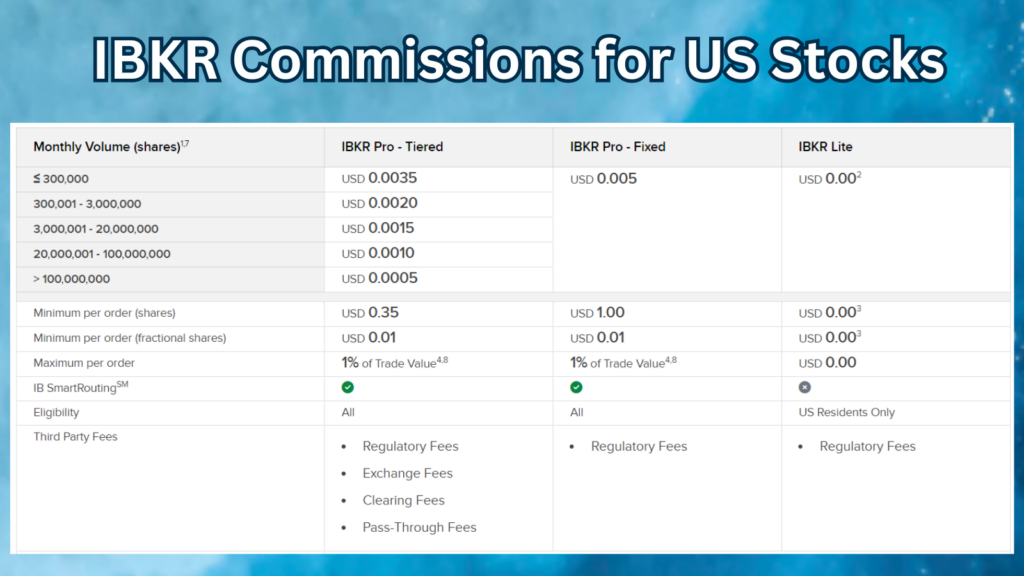
Interactive Brokers (IB) offers two distinct pricing structures, unlike many other brokers:
- Fixed pricing
- Tiered pricing
There's often confusion about which one to choose, so let's delve into a detailed comparison!
Fixed pricing is straightforward and easy to understand: you pay a fixed percentage fee with a minimum and maximum cap. This model is standard across most brokers.
On the other hand, tiered pricing consists of several sub-fees:
- Regulatory fees (only when selling)
- Exchange fees
- Clearing fees
- Pass Through fees
Some of these fees are per share, some are flat, and others are based on the total value.
Additionally, tiered pricing varies significantly between exchanges.
The key difference between the two models is that fixed pricing is simple and predictable, while tiered pricing is complex and varies greatly between exchanges.
It's worth noting that when you switch pricing methods, it typically takes one day for the change to take effect.
Ultimately, the cost per transaction is crucial to every investor. Therefore, we will compare Fixed and Tiered pricing schemes for US stocks since the United States hosts some of the greatest companies in the world.
Another thing to note is that you only pay the regulatory fees when you sell. But you have to pay the regulatory fees no matter if you are in the Fixed or Tiered pricing schemes or Lite account.
Buying US Stocks (Remove Liquidity) - Fixed vs Tiered Pricing
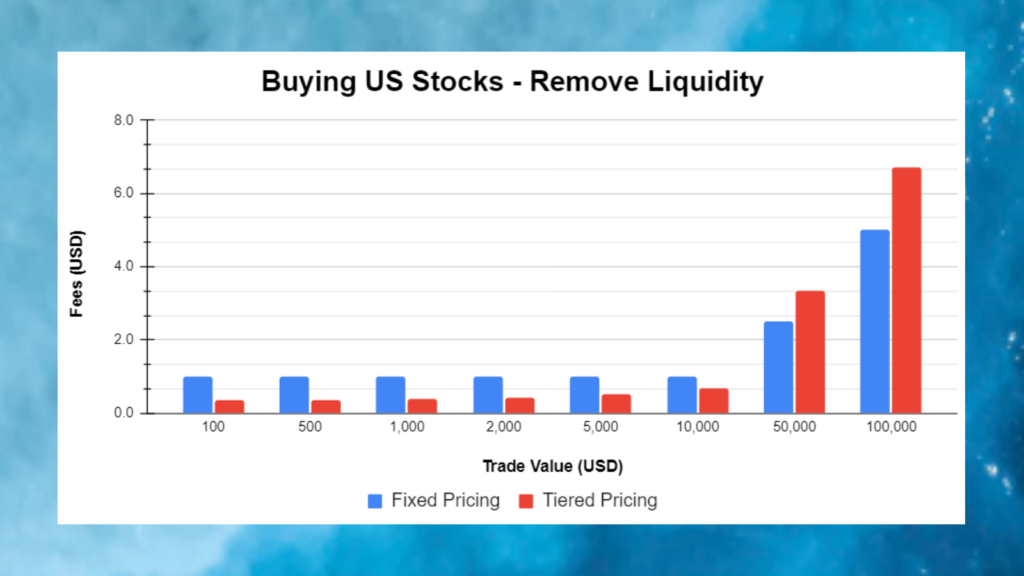
Let's examine the fee difference between Fixed pricing and Tiered pricing when buying US stocks and removing liquidity.
First, we have to understand the concept of liquidity.
Adding vs. Removing Liquidity: A Simpler Way to Think About It
Imagine the market like a pool of buyers and sellers. Adding liquidity is like jumping into the pool, creating more options for others. This happens when your buy order is below the current asking price or your sell order is above the current bid price. They are orders that are added to an exchange or ECN's order book before being executed. You might have to wait for someone to match your offer, but you're helping the market function smoothly, making other traders easier to buy and sell.
Rebates are the key benefits of adding liquidity.
On the other hand, removing liquidity is like grabbing water out of the pool. This happens when you buy at the asking price (what someone else is asking to sell for) or sell at the bid price (what someone else is offering to buy for). They are orders that are immediately executed against an existing bid or offer on an exchange's or ECN's order book. It's faster because you're not waiting for a match, but you might pay a little more for the convenience.
Speed and participation are the two key benefits of removing liquidity.
Think of Yourself as a Market Maker (Adding Liquidity) or a Regular Trader (Removing Liquidity)
Adding liquidity is like being a market maker, helping the pool function by offering to buy or sell at slightly different prices. You might get a small reward for this service. We call it rebates.
Taking liquidity is like being a regular trader, focusing on getting in and out of positions quickly. There's nothing wrong with this, and sometimes it's essential (like when a stock price is moving fast). Speed is the main benefit of taking liquidity, but it can cost you a bit more.
Now, let's get back to the calculations of commissions.
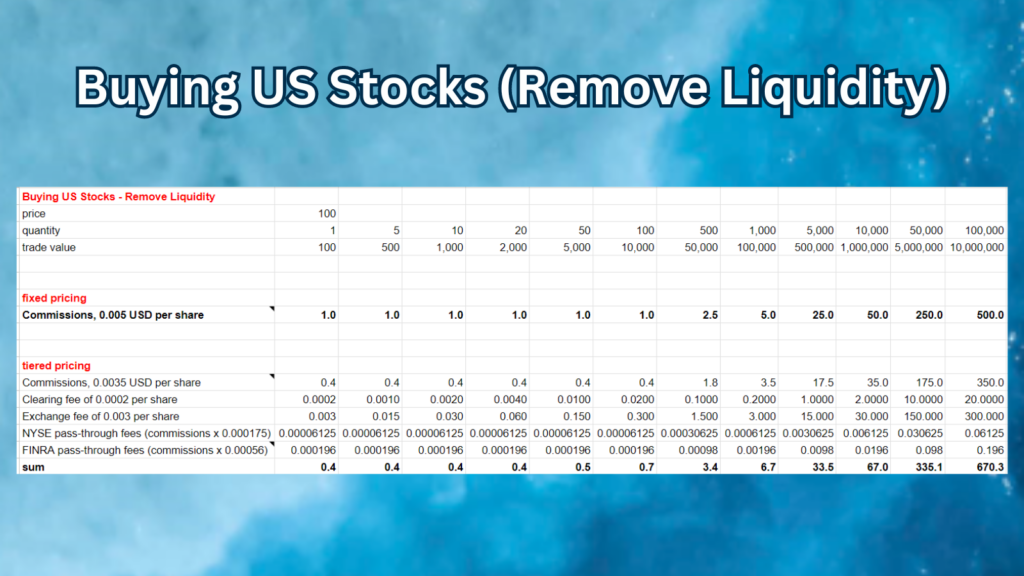
Interestingly, US exchanges charges commissions per share. Assuming we buy a stock with a share price of 100 US dollars each, purchasing $1000 worth of shares would mean acquiring ten shares.
What's also intriguing is the variation in fees between buying and selling. Let's start with the buying fees.
Under the fixed pricing model, the fee is 0.005 USD per share, with a minimum fee of 1 USD and a maximum fee of 1% of the trade value.
For tiered pricing, the commissions fee is 0.0035 USD per share, with a minimum fee of 0.35 USD and a maximum fee of 1% of the trade value. Additionally, there's a clearing fee of 0.0002 USD per share, an exchange fee of 0.003 USD per share, and two pass-through fees, including NYSE pass-through fees of commissions times 0.000175 and FINRA pass-through fees of commissions times 0.00056. The FINRA pass-through fee has a maximum of 8.30 USD per trade.
Summing it up, the graph shows the fees for buying US stocks when removing liquidity.
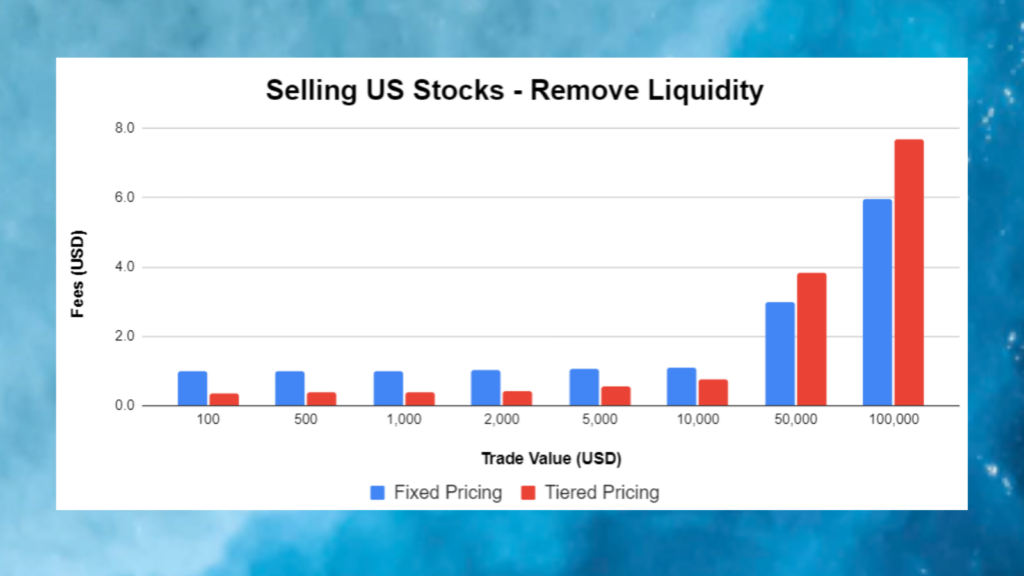
As you can see in the graph, the fee is cheaper under Tiered pricing for smaller trade value under 10,000 US dollars. On the other hand, the fee is cheaper under Fixed pricing for larger trade value above 50,000 US dollars.
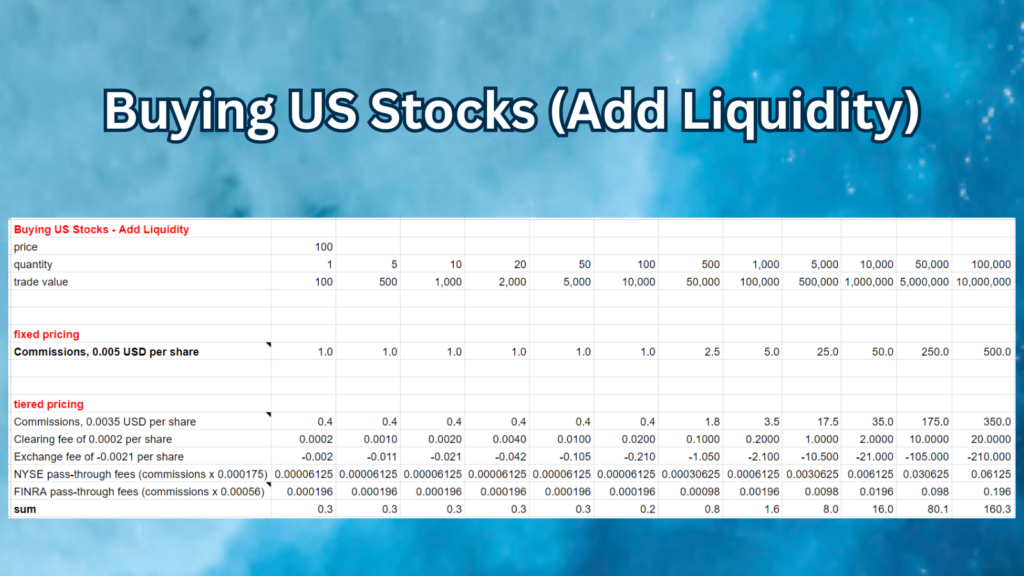
You can see the calculations of commissions in this Google Sheet document.
Selling US Stocks (Remove Liquidity) - Fixed vs Tiered Pricing
For sale operations, there are two additional regulatory fees:
- First, the SEC Transaction Fee of USD 0.000008 times the Value of Aggregate Sales
- Second, the FINRA Trading Activity Fee of USD 0.000166 per share, with a maximum of 8.3 USD
For value investors like me, we tend to buy stocks and businesses rather than sell. It's like we are net buyers of food over time. That's good because we pay less regulatory fees.
Another thing to be aware of is that you still have to pay the regulatory fees with an IBKR Lite account when you sell.
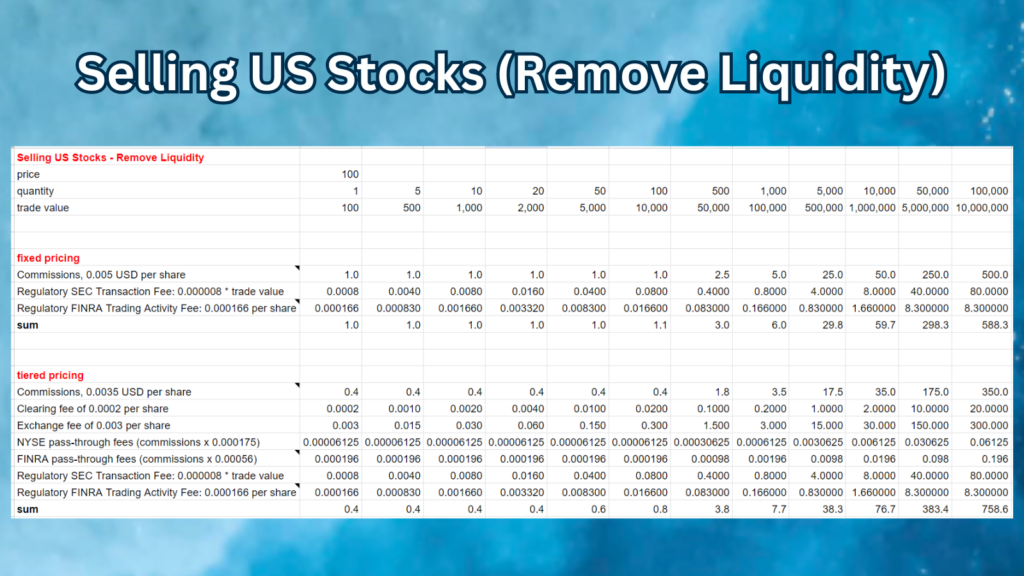
Similarly, when you sell and remove liquidity, tiered pricing is still cheaper on a smaller transaction and fixed pricing is cheaper on a bigger transaction. Specifically, if, on average, you have sell transactions of less than 50,000 US dollars, you choose tiered pricing. On the other hand, if you're kind of rich and generally have a selling transaction of above 50,000 US dollars, you choose fixed pricing.
Buying US Stocks (Add Liquidity) - Fixed vs Tiered Pricing
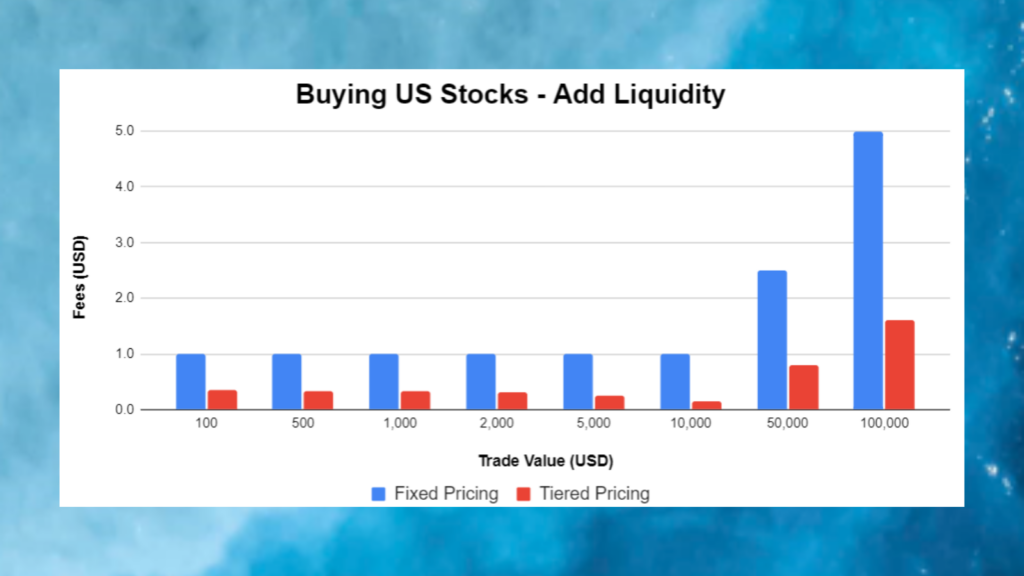
It's a totally different story when you add liquidity to the market because exchanges give you rebates. The exchanges pay you some cash when you make other buyers easier to buy and other sellers easier to sell.
Under fixed pricing, the fees you pay is the same between adding or removing liquidity because there is no exchange fees under fixed pricing, thus no rebates incurred with exchange fees.
Under tiered pricing, you save much when adding liquidity. For instance, when you buy 100,000 US dollars of stocks, if you are in a rush and buy on the ask, you have to pay a fee of 6.7 US dollars. If you can be patient and place a limit buy order on the bid, you only have to pay a fee of 1.6 US dollars when your order is being filled by another rich trader who is eager to sell.
So, as you can see in the graph, when you buy US stocks and add liquidity, it's always cheaper under tiered pricing compared to fixed pricing, no matter how big or small your trade value is. That's mainly due to the rebates you get when you add liquidity to the market.
Selling US Stocks (Add Liquidity) - Fixed vs Tiered Pricing
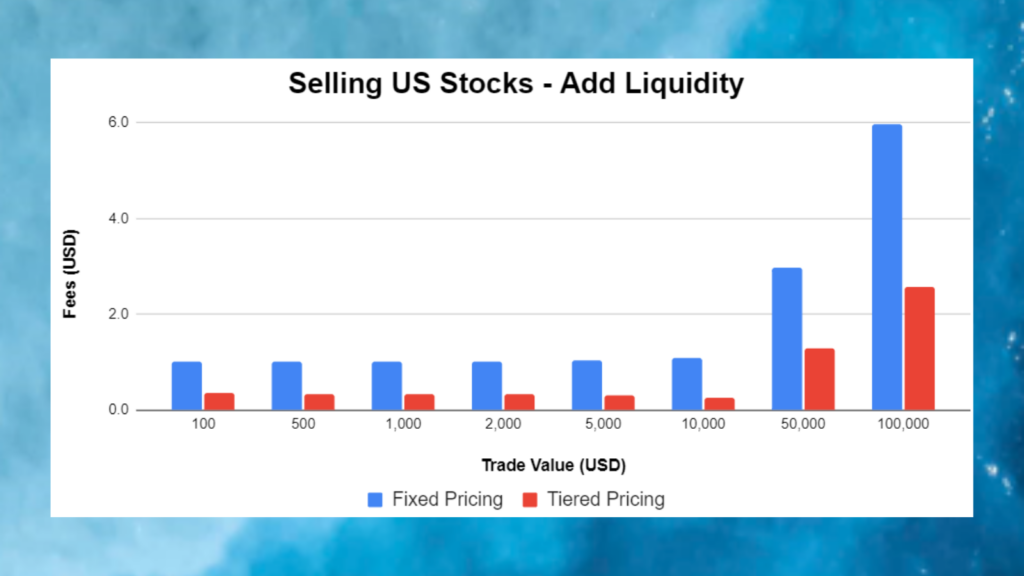
Next, we compare the fees you have to pay between fixed pricing and tiered pricing when you sell and add liquidity. Similarly, it's always cheaper for tiered pricing under all ranges of trade value if you can be patient and place your sell limit order on the ask.
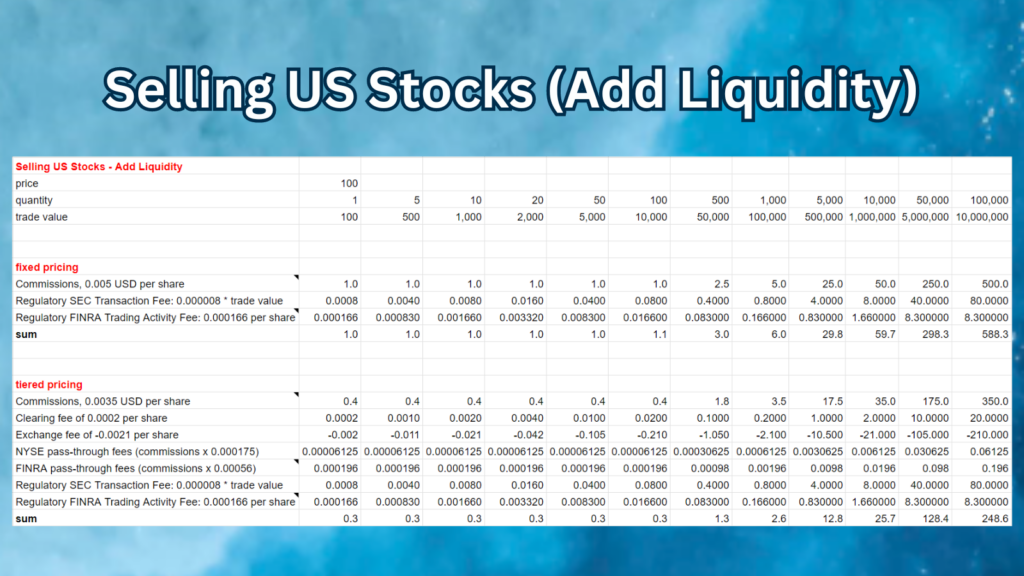
As a result, if on average, your trade value is less than 10,000 US dollars, I'll suggest you switch to tiered pricing for cost optimization. One thing to note is that IBKR sets its default to fixed pricing. So we're going to tell you how to switch to tiered pricing from fixed pricing.
How to Change Pricing Plan on Interactive Brokers (5 Simple Steps)
Switching your account from Fixed to Tiered pricing takes less than two minutes in the IBKR Client Portal.
Follow the step-by-step instructions below with actual account portal screenshots:
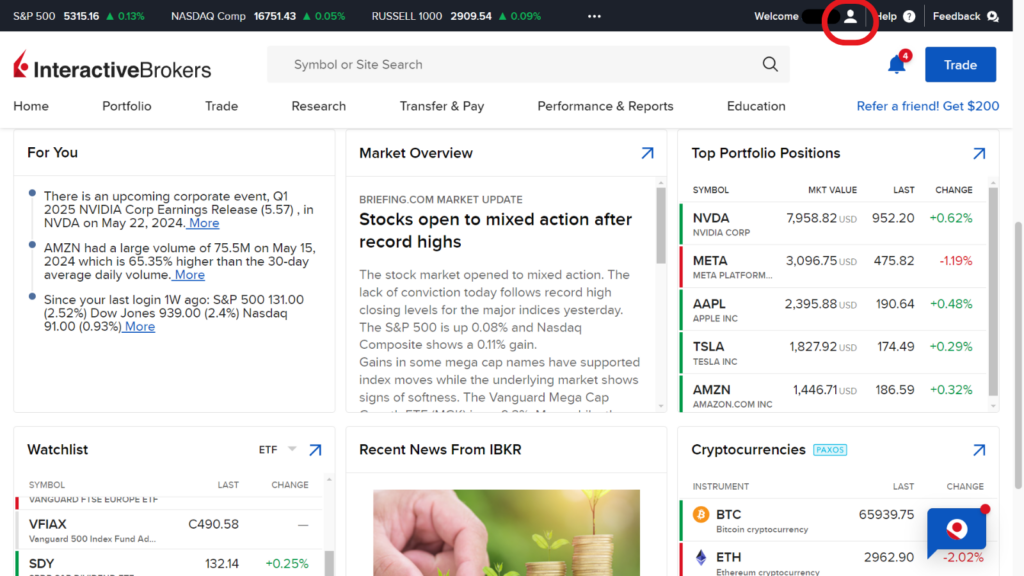
Step 1: Open the User Menu in Client Portal
Log in to your IBKR Client Portal and click the user icon in the top right corner.
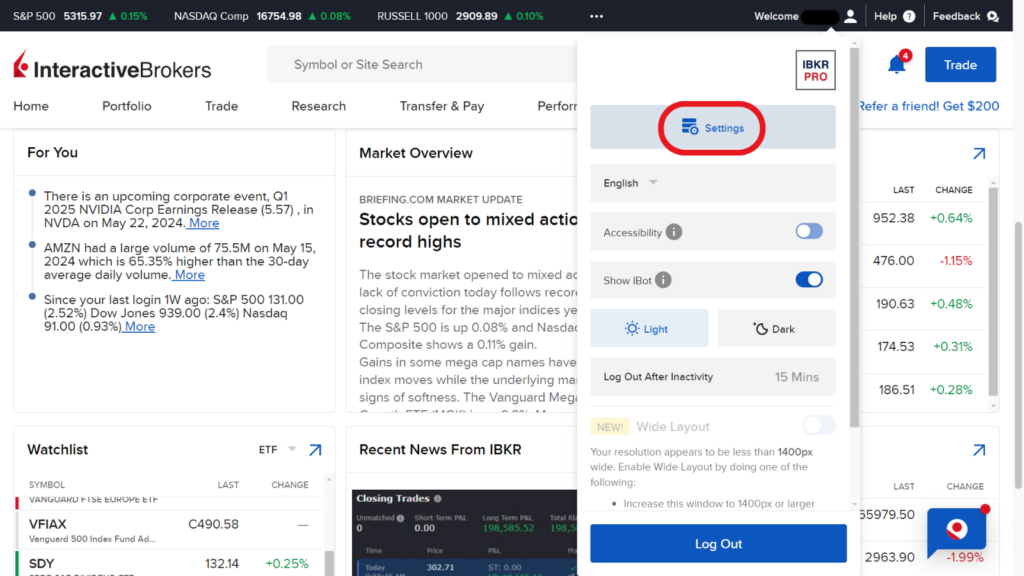
Step 2: Navigate to Account Settings
From the dropdown menu, select "Settings" to enter your overall account configuration dashboard.
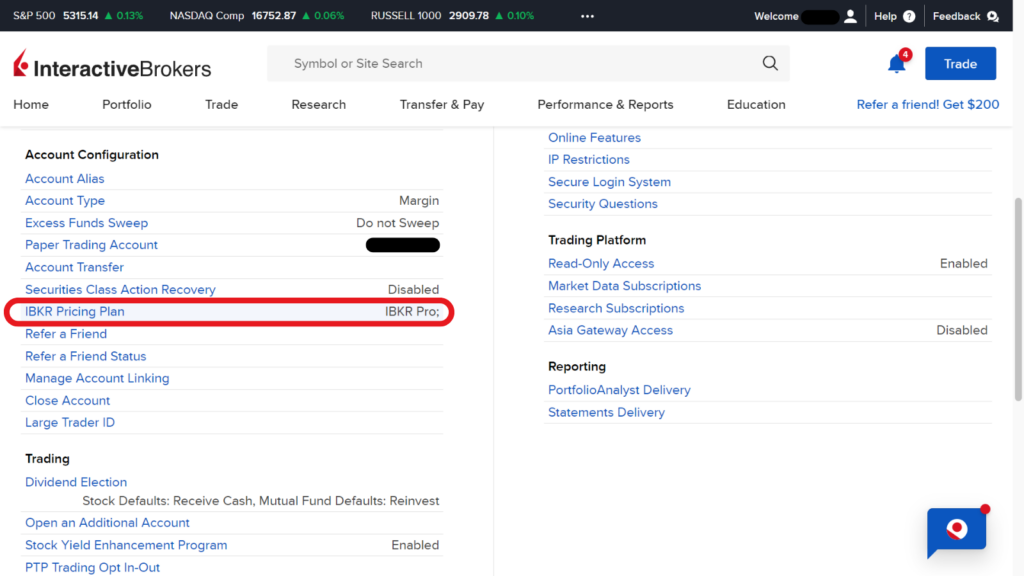
Step 3: Locate IBKR Pricing Plan
Scroll down to the "Account Configuration" section and click on "IBKR Pricing Plan".
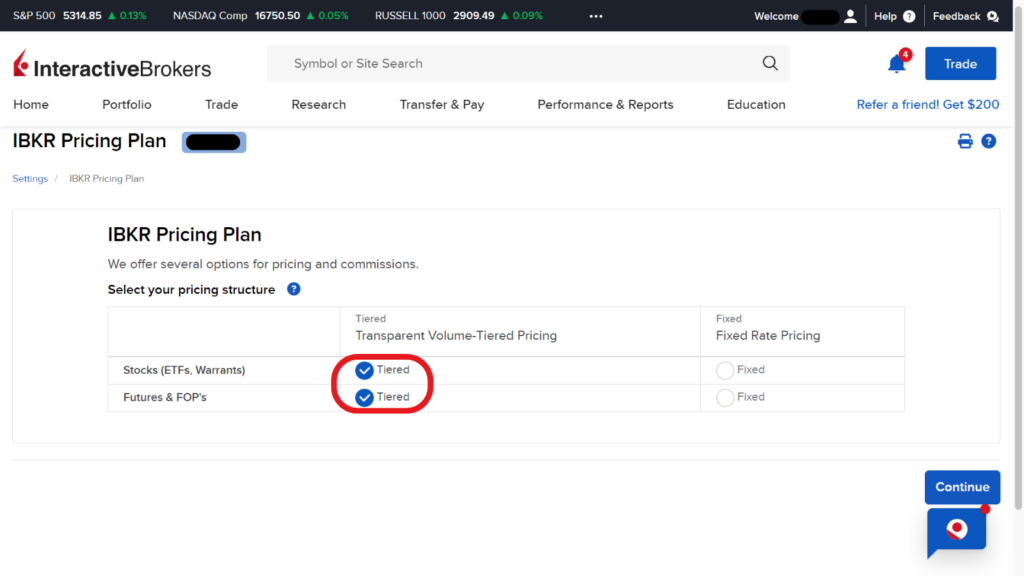
Step 4: Select Tiered Pricing
You will see that the default selection is Fixed. Change the radio button to Tiered and click Continue.
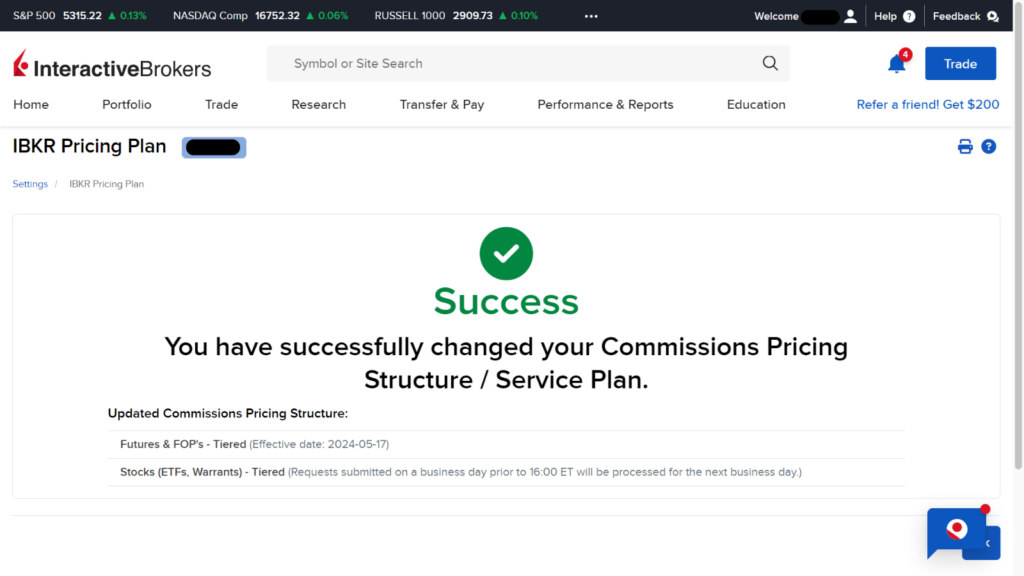
Step 5: Review and Confirm
Confirm your selection. The change will take effect on the next business trading day.
Summary: Optimize Your Investment Compounding Today
Interactive Brokers remains one of the safest, most competitive platforms worldwide, backed by NASDAQ listing and SIPC protection.
By switching to Tiered pricing, you immediately reduce your per-trade friction cost by up to 65%.
Do not let unnecessary commission drag erode your long-term compound wealth.

If you have not yet opened an IBKR account, use our Interactive Brokers Exclusive Referral Link to receive 1 IBKR stock worth $1 USD for every $300 deposited, with a maximum value of $1,000 in IBKR stocks.
Check your IBKR pricing plan settings today and let more of your money stay invested in high-quality assets.